
Introduction
Male infertility accounts for nearly half of all infertility cases worldwide, with male factors contributing to over 40% of the one in six couples affected during their reproductive years. A well-documented decline in semen quality — from 7–8% incidence in the 1960s to 20–30% today1,2 — has intensified the search for modifiable environmental drivers, including seasonal variation and ambient air quality.
Air pollution is an increasingly recognised contributor to this reproductive crisis, and India — particularly the rapidly urbanising Delhi/National Capital Region (NCR) — offers a compelling setting to study it: ambient air quality frequently deteriorates to hazardous levels, with winter Air Quality Index (AQI) peaking due to temperature inversion, reduced wind velocity, vehicular emissions, biomass burning, and agricultural stubble burning in adjoining states.
Standard semen analysis does not fully capture sperm functional competence,2 and the sperm DNA Fragmentation Index (DFI) — reflecting chromatin damage acquired during spermatogenesis, with values above 25–30% denoting clinically significant fragmentation — has emerged as a key adjunct. Elevated DFI is linked to poorer assisted reproductive technology (ART) outcomes, including reduced implantation and pregnancy rates and higher miscarriage risk,3 and may remain abnormal even with normal conventional parameters. The European Association of Urology now recommends DFI testing for diagnostic assessment and ART outcome prediction.
Several Indian studies show seasonal effects on conventional semen parameters,4–6 but whether this extends to sperm DNA integrity remains unclear. This study aimed to investigate the association between seasonal variation, ambient air quality, and DFI, alongside conventional semen parameters, in men referred for DFI testing at a tertiary in vitro fertilisation (IVF) centre in New Delhi over 10 years.
Materials and methods
Study Design
A comprehensive retrospective 10-year analysis was conducted in a single-centre, tertiary care IVF unit in New Delhi, India, from January 2016 to January 2026. Data were retrieved from the medical records of male patients who underwent DNA fragmentation index evaluation during this period. A total of 217 sperm DNA fragmentation index reports were identified and included. Each record contained patient age, date of analysis, body mass index (BMI), lifestyle variables (smoking and alcohol use), medical comorbidities, complete semen analysis parameters, and DFI result.
Sample Collection and Analysis
Semen samples were collected by masturbation into a sterile, wide-mouth polystyrene container at the clinic, following an abstinence period ranging from less than 24 hours to seven days, and analysed according to World Health Organisation (WHO) classification criteria.7 Sperm DNA fragmentation was assessed using a commercially available Sperm Chromatin Dispersion (SCD) kit (Sperm Chroma Kit), a validated and widely used method in which fragmented and non-fragmented spermatozoa are distinguished by the absence or presence, respectively, of a halo of dispersed chromatin.3 For each sample, 300 spermatozoa were evaluated by one of two trained in-house embryologists as part of routine clinical practice. DFI was categorised as ≤15% (Excellent), 15.1–25% (Good), 25.1–50% (Poor), and >50% (Very Poor). Samples were grouped into four seasons according to Indian Meteorological Department (IMD) terminology based on the date of collection: Winter (December–February; n=66), Pre-monsoon (March–May; n=51), Monsoon (June–August; n=50), and Post-monsoon (September–November; n=50).
Inclusion and Exclusion Criteria
Male partners of couples presenting for fertility evaluation, aged 22-50 years, who were advised sperm DNA fragmentation index (DFI) testing based on clinical indications, including recurrent implantation failure (RIF), recurrent pregnancy loss (RPL), unexplained infertility, etc were included in the study. Participants were excluded if they had a history of hormonal therapy, tuberculosis, mumps orchitis, sexually transmitted diseases, hydrocele, untreated varicocele, undescended testes, or inguinal hernia surgery, or known genetic or chromosomal abnormalities. Men with a history of malignancy or those undergoing chemotherapy or radiotherapy were also excluded.
Ambient Air Quality Data
Ambient air pollution data were obtained from the Central Pollution Control Board (CPCB), Government of India (https://cpcb.nic.in/national-air-quality-index). Key environmental variables — AQI, ambient temperature, and relative humidity — were retrieved as monthly mean values of Delhi city (city-level data) corresponding to the time period of sample collection, and, for the lag-adjusted analysis, as the mean over the three calendar months preceding collection. AQI values were categorised as: <100 (satisfactory), 101–200 (moderate), and >201 (poor).
Statistical Analysis
Data analysis was conducted using SPSS v25 (IBM Corp., Armonk, NY, USA). This retrospective observational study used descriptive statistics to summarise participant characteristics, reporting continuous variables as mean ± standard deviation or median (range) and categorical variables as frequencies and percentages. The primary outcome was the Sperm DNA Fragmentation Index (DFI), and secondary outcomes included conventional semen parameters, including sperm concentration, progressive motility, morphology, and total motile sperm count (TMSC). Seasonal variations and differences across Air Quality Index (AQI) categories were evaluated using comparative statistical tests. To assess relationships between environmental factors (temperature, humidity) and semen quality, Spearman’s rank correlation coefficients (rho) were calculated. DFI was not normally distributed across the four seasons. Thus, non-parametric tests (Kruskal-Wallis test) were used to make group comparisons. All statistical comparisons were two-tailed, and a significance threshold of p<0.05 was applied to determine statistical relevance. A multivariable linear regression was fitted for each semen parameter on the two environmental exposures — ambient temperature and Air Quality Index (AQI) — with simultaneous adjustment for the confounders such as age, body mass index (BMI), smoking, alcohol, and abstinence period to clarify the independent contribution of environmental variables to DFI. To account for the ~90 days interval of spermatogenesis and epididymal transit, a Lag adjusted analysis was done and the environmental exposures were re-expressed as the mean over the three preceding months. Spearman correlations were used throughout because the parameters are non-normally distributed.
Ethical Approval
The institutional research committee approved the study, and ethical clearance was obtained from the ethics committee of the institution. REF NO: EC/NEW/IND/2022/DL/0233. The study has been conducted in accordance with the ethical principles mentioned in the Declaration of Helsinki (2013). Patient consent was waived due to the retrospective observational nature of the study.
Results
Participant Characteristics
A total of 217 men were included, aged 22–50 years (mean 36.01±4.93), with mean BMI 26.98±4.23 (median 26.40; range 14.40–41.90). Smoking was reported by 33.2% (n=72) and alcohol use by 54.4% (n=118). Medication use was reported by 28.1% (n=61) — antihypertensives (4.1%), lipid-lowering agents (3.7%), diabetic medications (2.3%), thyroid medications (1.4%), others (1.8%) — and regular multivitamin use by 16.6% (n=36). Medical comorbidities were present in 15.7% (n=34): hypercholesterolaemia (4.1%), hypertension (3.7%), diabetes (2.8%), hypothyroidism (1.4%), autoimmune disorders (1.4%), and others (4.1%). Most samples were collected after one to three days’ abstinence (65.4%; n=142), with 21.2% (n=46) under 24 hours and 13.4% (n=29) beyond three days. Participant demographic and clinical characteristics are summarised in Supplemental Table 1.
Seasonal and Environmental Patterns
Seasonal meteorological patterns remained broadly consistent over the decade. In North India, monsoon (June–August) coincides with persistently high temperatures despite rainfall, recording the highest mean temperature (31.40±1.59°C), lowest mean AQI (109.28±48.66), and intermediate humidity (71.42±11.13%). Winter (December–February) had the lowest temperatures (15.17±2.21°C), highest AQI (297.11±53.40), and highest humidity (79.41±5.76%), while pre-monsoon (March–May) was hot and dry (27.92±3.46°C; humidity 54.10±9.17%, the lowest). Seasonal meteorological data are presented in Supplemental Table 2.
Conventional Semen Parameters and Seasonal Variation
Semen volume showed minor inter-seasonal variation (highest in monsoon, 2.31±1.21 mL; lowest in pre-monsoon, 1.97±0.90 mL; p=0.423). Sperm concentration was higher in winter (32.74±18.08×10⁶/mL) and monsoon (32.47±21.72×10⁶/mL) than pre-monsoon (28.18±18.09×10⁶/mL) and post-monsoon (28.22±17.80×10⁶/mL; p=0.399). Progressive motility declined from winter (52.82±24.18%) to a monsoon nadir (43.28±25.65%; p=0.185). The immotile fraction varied significantly (p=0.035): lowest in winter (15.09±17.13%), highest in monsoon (25.68±24.41%). TMSC was highest in winter (28.70±25.49×10⁶) and lowest in post-monsoon (21.68±19.42×10⁶; p=0.198). Sperm morphology varied significantly by season (p=0.036): normal morphology was highest in winter (20.09±13.90%), declining through pre-monsoon (15.53±12.58%) and post-monsoon (14.16±10.63%) to a monsoon nadir (12.86±9.75%). OATS (oligo-astheno-teratozoospermia) proportions did not differ significantly across seasons (p=0.553, 0.280, 0.519 respectively), though all three were most frequent in monsoon (30.0%, 34.0%, 20.0%). Conventional semen parameters by season are presented in Table 1.
Sperm DNA Fragmentation Index: Seasonal Variation
The DFI demonstrated the most pronounced and statistically significant seasonal variation amongst all parameters assessed (p=0.009). Strikingly, DFI was lowest in winter [median 27.75% (IQR 20.62–37.62); mean 28.67±10.43%] and pre-monsoon [median 25.50% (IQR 19.50–31.00); mean 27.59±11.83%], but worsened considerably in post-monsoon [median 31.00% (IQR 23.50–42.50); mean 35.02±18.92%] and peaked in monsoon [median 32.25% (IQR 24.50–45.50); mean 38.06±19.87%]. Categorical analysis revealed a progressive increase in the proportion of men with very poor DFI (>50%): 1.5% in winter (n=1), 5.9% in pre-monsoon (n=3), 12.0% in post-monsoon (n=6), and 18.0% in monsoon (n=9) (p=0.004). Importantly, throughout all seasons, DFI consistently remained above 25%, placing it within the poorer range. Paradoxically, winter — with the lowest mean temperature, highest humidity, and poorest AQI — was associated with the most favourable DFI values, underscoring the complex interplay between environmental factors and DFI outcomes. Seasonal DFI data are presented in Table 1. Because DFI was non-normally distributed, median (IQR) values were compared using the Kruskal-Wallis test. A significant seasonal variation in DFI was observed (χ² = 11.478, p = 0.009), with the lowest median DFI occurring during winter, the season with the lowest ambient temperatures, and the highest median DFI during the monsoon, the hottest season in North India. These findings indicate that lower ambient temperatures are associated with better sperm DNA integrity, whereas exposure to higher seasonal temperatures is associated with significantly greater sperm DNA fragmentation.
Conventional Semen Parameters and Air Quality (AQI, Temperature, and Humidity)
Conventional semen parameters showed no significant associations across AQI categories (sperm concentration p=0.168; progressive motility p=0.361; normal morphology p=0.474; TMSC p=0.600), though sperm concentration trended lower with worsening air quality (AQI<100: 35.88±25.25 million/mL vs. AQI>200: 29.05±17.63 million/mL). Ambient temperature was lower among men with normal sperm concentrations than those with oligospermia (non-significant), and correlated significantly with poorer normal morphology (rho=-0.18, p=0.008); men with asthenozoospermia were exposed to significantly higher temperatures than those with normal motility (26.33±6.75°C vs. 23.95±7.06°C, p=0.014). Humidity showed minimal influence overall except for progressive motility (p=0.029; normal motility 71.56±12.10% vs. reduced 67.60±13.21%); associations with sperm concentration and morphology were not significant (p=0.387, p=0.121). Detailed associations are in Supplemental Tables 3–5.
DFI and Air Quality
DFI varied significantly across AQI categories (p=0.005), counterintuitively highest at the lowest AQI [<100: median 39% (IQR 26-61); mean 44.82±25.18%] versus moderate [101–200: median 26.75% (IQR 20.62-36.38); mean 29.26±12.41%] and high [>201: median 28.5% (IQR 20.5-38.5); mean 29.65±11.71%] categories. Temperature was similar across excellent, good, and poor DFI categories (~24°C) but notably higher in the very poor category (>50%: 28.95±4.06°C), though not statistically significant (rho=0.09, p=0.176). DFI showed no significant correlation with humidity (rho=0.07, p=0.298). These associations are presented in Supplemental Table 3.
DFI and Semen Parameters
DFI showed an increasing trend with age (p=0.524) and was lower with shorter abstinence [<24h: median 25% (IQR 18.62-36.12); mean 27.07±11.13%] than prolonged abstinence [>3 days: median 27.5% (IQR 22-49); mean 34.93±19.21%; p=0.085]. Elevated DFI was consistently associated with poorer semen quality: asthenozoospermia [median 41.25% (IQR 29.75-48.88) vs 26.5% (IQR 19.5-34.25); mean 43.61±20.38% vs 27.83±11.48%; p<0.001], teratozoospermia [median 41.5% (IQR 29.5-49) vs 27.25% (IQR 20.5-36.5); mean 43.15±19.45% vs 30.05±14.42%; p<0.001], and oligospermia [median 37.25% (IQR 26.5-42.5) vs 26.5% (IQR 19.5-36.5); mean 37.25±17.03% vs 30.23±15.20%; p=0.001], with significantly lower TMSC in the higher-DFI group (p=0.017). See Supplemental Table 6.
Lag Analysis of Environmental Exposures and Sperm DNA Fragmentation
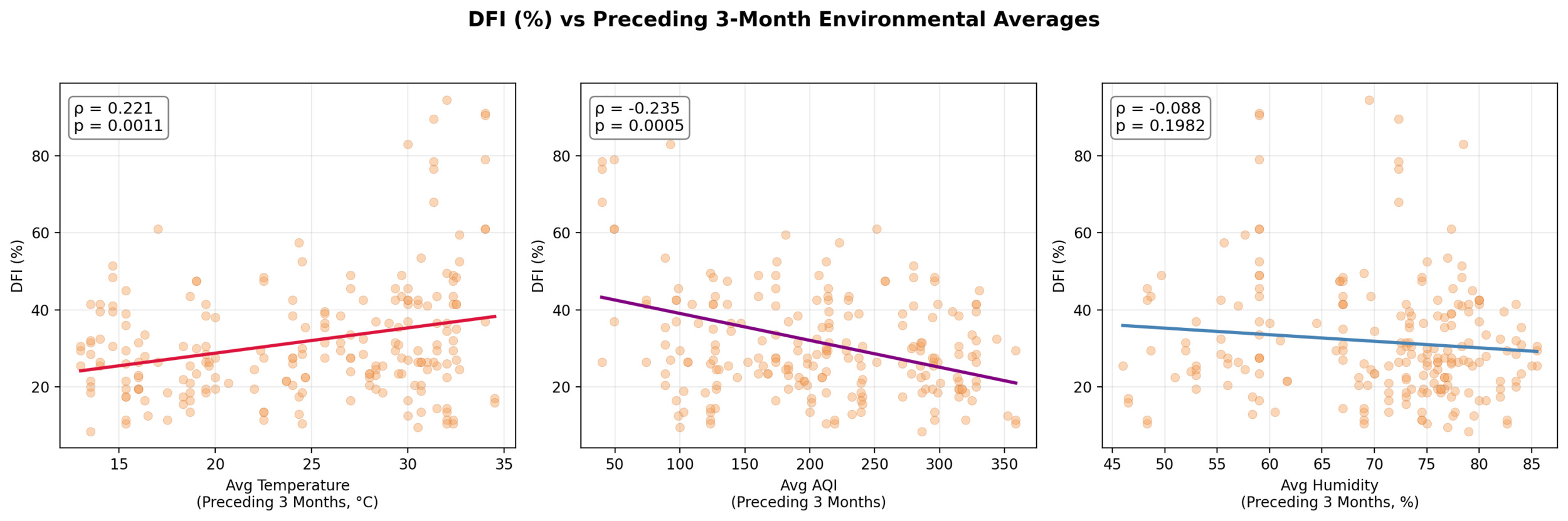
To evaluate the influence of environmental exposures during spermatogenesis, lag-adjusted correlations were computed using the mean ambient temperature, Air Quality Index (AQI), and relative humidity over the three months preceding sample collection, and compared against same-month (concurrent) exposures. The concurrent temperature–DFI correlation was weak and non-significant (rho=0.09, p=0.176); aligning exposure to the preceding quarter markedly strengthened this association (rho=0.22, p=0.001), indicating that prolonged heat exposure during the spermatogenic window, rather than temperature at the time of collection, is associated with increased sperm DNA fragmentation. AQI showed an inverse correlation with DFI at both the concurrent (rho=-0.15, p=0.024) and lagged (rho=-0.24, p=0.0005) windows, while average relative humidity showed no significant association (rho=-0.09, p=0.198). Because ambient temperature and AQI are strongly and inversely correlated across seasons (rho=-0.69) — winter combines the year’s highest AQI with its lowest temperatures — part of the apparent AQI-DFI association likely reflects this shared seasonal variation rather than a truly independent effect of air quality; the lag-strengthened temperature association suggests that thermal exposure during spermatogenesis may be a more biologically plausible driver of seasonal DFI variation. Correlations for contemporaneous versus lag-adjusted exposures are summarised in Supplemental Table 7, Figure 1 and supplemental Figure 1.
_and_preceding_3-month_(lag-adjuste.png)
Multivariable Regression Analysis for Predictors of Sperm DNA Fragmentation
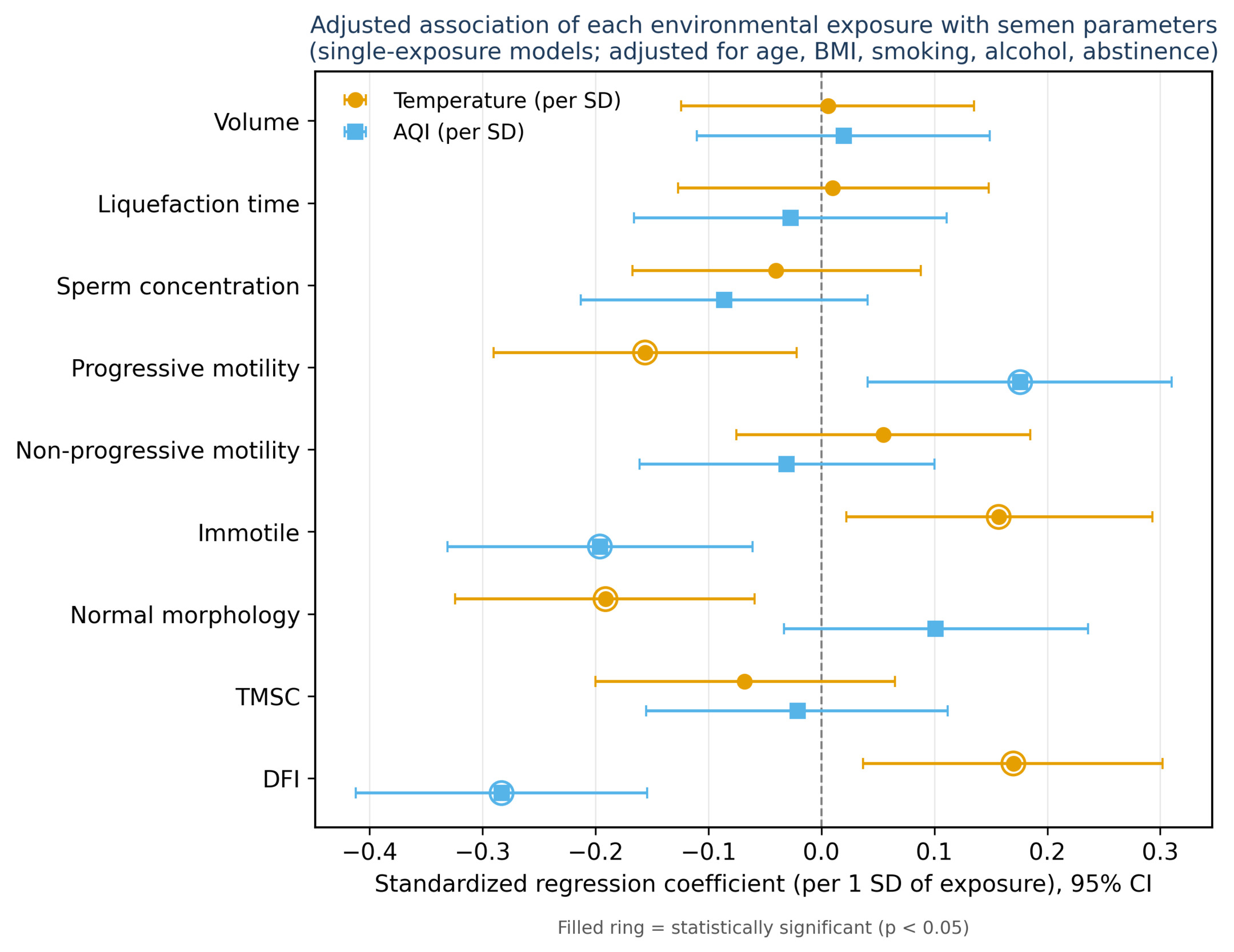
Multivariable linear regression was performed to identify independent predictors of DFI after adjusting for age, BMI, smoking, alcohol use, and abstinence period, together with ambient temperature and AQI. In univariable analysis, higher ambient temperature was significantly associated with increased DFI (β=0.35, 95% CI: 0.05–0.65; p=0.022), whereas higher AQI was significantly associated with lower DFI (β=-0.05, 95% CI: -0.07 to -0.02; p<0.001). Age, BMI, smoking, and alcohol use were not significant univariable predictors, whereas a longer abstinence period (1–3 days vs. <1 day) was associated with higher DFI (β=6.00, p=0.026). In the multivariable model, temperature was attenuated to non-significance (β=-0.28, 95% CI: -0.73 to 0.18; p=0.237), whereas AQI remained an independent and strengthened predictor of DFI (β=-0.06, 95% CI: -0.10 to -0.03; p<0.001). BMI (β=-0.40, p=0.109) was no longer significant after adjustment, while the 1–3 day abstinence category retained a significant positive association with DFI (β=5.39, p=0.046). The overall model was statistically significant (F(8,208)=4.28, p<0.001; R²=0.141, adjusted R²=0.108). Variance-inflation factors for temperature and AQI (2.56 and 2.58) indicated moderate collinearity between the two exposures. When modelled individually, temperature was independently and positively associated with DFI (β=0.38, 95% CI: 0.08–0.68; p=0.012), consistent with the lag-adjusted findings, while AQI remained independently and inversely associated with DFI (β=-0.05, 95% CI: -0.07 to -0.03; p<0.001). Full regression results are presented in Figure 2 and Table 2.
Discussion
This study demonstrates significant, reproducible seasonal variation in sperm quality parameters — most notably DFI — in men referred for DFI testing at a tertiary IVF centre in New Delhi over ten years, contributing to the limited evidence on DFI and its environmental determinants in northern India’s unique climatic profile.
Seasonal Variation in DFI: The Central Finding
DFI was significantly lower in winter and pre-monsoon, worsening progressively through post-monsoon to peak in the hottest monsoon months (p=0.009), with very poor DFI (>50%) rising nearly seven-fold from winter (1.5%) to monsoon (18.0%) (p=0.004) — consistent with a cumulative detrimental effect of warmer conditions on sperm DNA integrity. This aligns with Wang et al. (2024), who found high-temperature extremes independently associated with higher DFI across BMI strata in 11,877 men.1 A plausible mechanism is testicular thermoregulation: spermatogenesis is highly temperature-sensitive, and even modest scrotal heat increases may promote oxidative stress, disrupting DNA integrity via reactive oxygen species-induced strand breaks.8,9 Notably, mean DFI remained above 25% across all seasons, suggesting persistently compromised sperm DNA integrity reflecting the chronic environmental burden of urban Delhi — and that conventional semen parameters alone may underestimate underlying sperm dysfunction.
The Delhi Paradox: Best DFI in the Most Polluted Season
A particularly counterintuitive finding was that winter — despite Delhi’s worst ambient air quality — was paradoxically associated with the most favourable mean DFI. This contradicts most existing literature: Talwar et al. (2024), presenting a retrospective analysis of 3,222 patients across 120 Indian fertility centres in a conference abstract, reported higher AQI categories associated with significantly more abnormal DFI (>25%).10 A 2025 meta-analysis (Margiana et al., 17 studies, 24,065 participants) similarly confirmed higher DFI with greater air pollution exposure (weighted mean difference +5.41%; 95% CI 3.24–7.59; p<0.001).11 Our findings are not entirely without precedent from Delhi itself: Gupta et al. (2020), comparing semen parameters between 521 men from urban Delhi/NCR and 136 men from semi-urban adjoining states over a single ~6-month window (August 2019-January 2020), found no significant difference in conventional semen parameters between the two populations, and called for longer-term studies incorporating seasonal variation.12 Our data extend this to sperm DNA integrity and tested its robustness via lag-adjusted analysis (~90-day spermatogenic window) and multivariable regression (age, BMI, smoking, alcohol, abstinence) specifically to test whether the inverse AQI-DFI association could be explained by exposure-timing mismatch or confounding. Neither attenuated the relationship — AQI’s association with DFI strengthened after lag-adjustment (rho=-0.24, p=0.0005 vs. rho=-0.15, p=0.024 contemporaneously) and remained significant in the multivariable model (β=-0.06, p<0.001). We retain the term “paradox” advisedly: part of this likely reflects collinearity between temperature and AQI across seasons, yet the relationship persisted across multiple analytic approaches relative to current biological understanding. Because AQI and temperature were measured at the population level and are inherently confounded by season, the inverse AQI-DFI association may partly reflect seasonal collinearity and the ecological nature of the exposure data rather than an independent effect of air quality. Furthermore, the retrospective, observational design precludes causal inference. Therefore, the “Delhi paradox” should be considered an exploratory observation rather than a definitive causal conclusion that requires confirmation in subsequent prospective studies.
We propose three explanations. First, spermatogenesis and epididymal transit span ~90 days, so winter-collected sperm reflect preceding-autumn conditions (falling temperatures) rather than peak winter pollution — borne out by lag-adjusted analysis: ambient temperature averaged over the ~90 days preceding sample collection correlated significantly and positively with DFI (rho=0.22, p=0.001), whereas contemporaneous temperature did not (rho=0.09, p=0.176). This is consistent with heat exposure during the preceding spermatogenic cycle, rather than at the time of collection, drives DNA damage. Second, genetic susceptibility likely modulates this relationship: Rubes et al. (2010) showed xenobiotic-metabolising gene polymorphisms (CYP1A1, GSTM1, GSTP1, GSTT1) significantly affect sperm DNA damage from air pollutant exposure.13 No genetic testing was performed in our cohort, so individual-level susceptibility remains uncharacterised. Third, pollution-related mechanisms (PAH–DNA adducts, PM2.5-driven endocrine disruption, epigenetic modification) likely act on a chronic, cumulative timescale rather than sharp seasonal fluctuations — explaining why lag-adjustment sharpened rather than resolved the AQI–DFI relationship. We cannot offer a confirmed mechanistic explanation for this paradox; we present it as a genuine, statistically robust finding warranting replication and mechanistic investigation in future studies.
Seasonal Variation in Sperm Morphology and Motility
The significant seasonal decline in normal morphology (p=0.036) aligns with published Indian data: Malathi et al. (2023) reported seasonal semen variation favouring cooler months in Kerala6; Shiny Jenefa et al. (2024), analysing 1,830 semen samples from Chennai over 2020–2024, confirmed significant seasonal variation in sperm concentration and total count driven by temperature, though morphology was less affected — likely because Chennai’s tropical climate has smaller seasonal temperature swings than northern India.5 A recent Indian study of 1,345 men similarly found that sperm count, total motility, progressive motility, and morphology were all significantly higher in winter and lowest in the monsoon season.14
# Wider Implications
Existing evidence underscores the downstream consequences of elevated DFI on reproductive outcomes. Yang et al. (2025) found higher DFI reduced blastocyst formation and transferable embryos dose-dependently in 5,271 IVF cycles,15 though Yao et al. (2024) found no association with recurrent pregnancy loss in 1,485 participants, suggesting DFI’s clinical significance varies by outcome.16 Our study adds an environmental and temporal dimension to this evidence. By demonstrating that DFI is significantly higher in monsoon and lowest in winter, our findings raise the possibility that ART cycle timing could be a modifiable variable; however, we regard this as hypothesis-generating rather than an immediate clinical recommendation. For men with suboptimal semen parameters, recurrent implantation failure, or unexplained pregnancy loss, seasonal DFI fluctuation may be a factor to bear in mind when timing sperm collection or cryopreservation. Incorporating season and environmental air quality into the male fertility workup may represent a low-cost avenue worth prospective evaluation as a strategy to improve ART outcomes in India’s urban reproductive health landscape.
Limitations
Several limitations merit acknowledgement: the retrospective, single-centre design precludes causal inference and limits generalisability; the modest sample (n=217 over 10 years) represents men referred for DFI testing rather than a general population; environmental variables were obtained as monthly mean values for Delhi city from CPCB data, rather than from a single monitoring station or from daily or individual-level exposure measurements, limiting temporal and spatial precision in exposure-outcome timing and potential for ecological bias; specific pollutants (PM2.5, PM10, NOx, O3) and indoor air pollution were not captured; no oxidative stress biomarkers, reproductive hormones, or genetic testing (xenobiotic-metabolising polymorphisms — GSTM1, GSTP1, CYP1A1, GSTT1) were assessed, limiting mechanistic interpretation and individual susceptibility assessment13; and no inter-observer agreement statistic was calculated for SCD slide reading. Larger prospective cohorts with individual-level exposure data, oxidative stress biomarkers, and genetic profiling are warranted.
Conclusions
The Indian environmental context — extreme seasonal temperatures and chronically hazardous air pollution — represents a uniquely high-burden setting for male reproductive health. Semen parameters and DFI are dynamic, environmentally modulated biomarkers with clinically meaningful seasonal variation: monsoon was consistently associated with poorer sperm DNA integrity, reduced motility, morphology and higher OATS frequency, while winter paradoxically showed the most favourable characteristics despite the lowest temperatures and poorest AQI, in this cohort of men referred for DFI testing at a tertiary IVF centre in New Delhi. Notably, even the most favourable mean DFI values observed in winter remained within the poor DFI range (>25%), highlighting the persistently compromised reproductive milieu in this population. These findings point to a complex, non-linear interplay between heat, air quality, and male fertility, and addressing modifiable environmental exposures may offer a practical avenue to reduce the growing burden of male infertility and possibly improve ART outcomes.
Presentation at a meeting
Not presented at any conference or meeting.
Funding statement
No external funding was received for this project.
Conflict of interest statement
The authors declare no conflicts of interest.
CRediT authorship contribution statement
Nipasa Sarma: Conceptualization, Methodology, Formal analysis, Investigation, Data curation, Writing – original draft, Writing – review & editing.
Tanya Buckshee Rohatgi: Conceptualization, Supervision, Resources, Writing – review & editing.
Attestation statements
The subjects in this study have not concomitantly been involved in other randomized trials (not applicable; this is a retrospective observational study, not a trial).
Data related to any of the subjects in the study has not been published previously.
All study and manuscript data will be made available to the journal editors upon request before and/or after manuscript publication for review or query.
The authors followed the STROBE checklist for this study design.
Data sharing statement
Data are available on request from the corresponding author (Dr. Nipasa Sarma, nipasasharma@gmail.com).
Trial registration
Not applicable (not a clinical trial).
Ethical approval
The institutional research committee approved the study, and ethical clearance was obtained from the ethics committee of the institution (REF NO: EC/NEW/IND/2022/DL/0233). The study was conducted in accordance with the ethical principles of the Declaration of Helsinki (2013).
Patient consent statement
Patient consent was waived due to the retrospective observational nature of the study.
Acknowledgements
Mr. Sandesh Patel, Embryologist, and Mr. Devendra Kumar, Data collection.
Declaration of generative AI and AI-assisted technologies in the writing process
During the preparation of this manuscript, the authors used Claude AI (Anthropic) for language editing and manuscript preparation. The authors reviewed and edited all AI-assisted content as needed and take full responsibility for the content of this article.